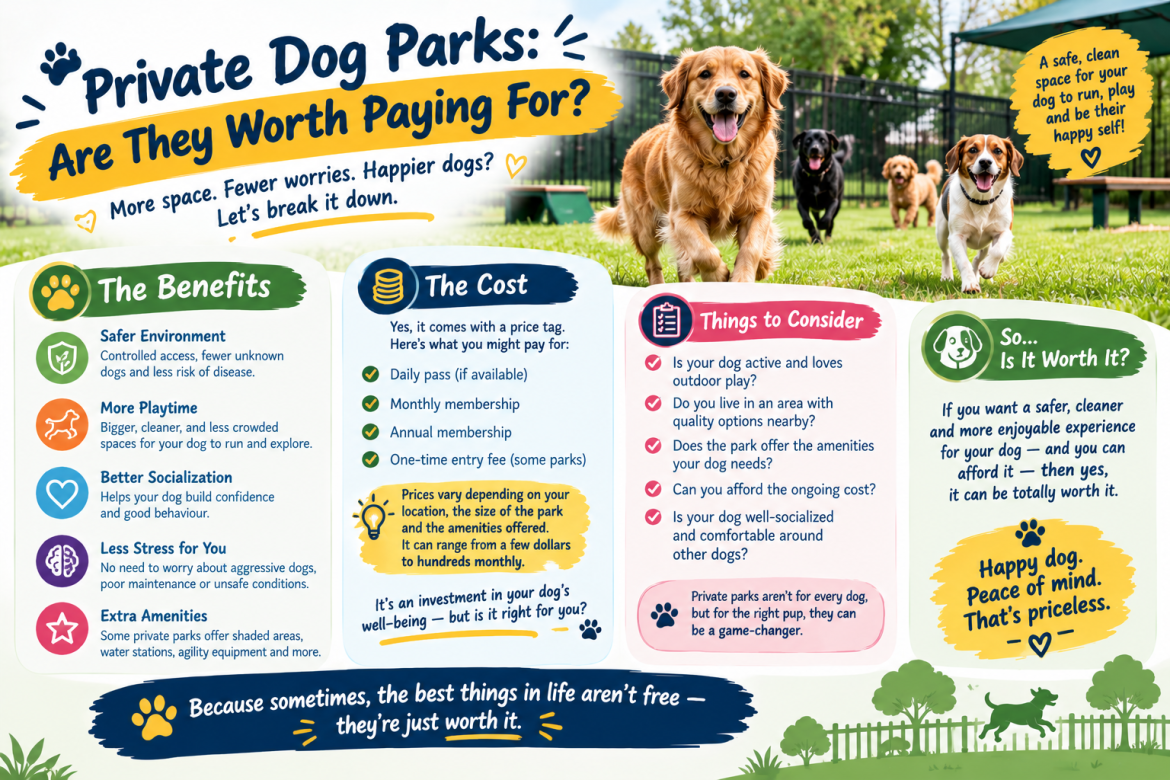
Public dog parks can be great. They can also be chaos. Off-leash dogs of every size and temperament, owners glued to their phones, a muddy patch near the gate, and the occasional scuffle. So it’s no surprise that private dog parks have started popping up in cities and suburbs.
You pay a fee, you get a fenced space, and, in theory, a calmer experience. But is it really worth the money? Let’s weigh it up.
What is a private dog park?
A private dog park is an enclosed space you can rent or join, usually for off-leash play. Some are membership-based, some charge per visit, and some let you book a private time slot, like renting a field just for you and your dog.
They vary quite a bit. Some are simple fenced lots. Others have agility equipment, water features, shade, benches, and even indoor sections for bad weather.
Why people choose them
Common reasons include safety, control, and peace of mind. Many owners like knowing who else is using the space. Some parks screen dogs, requiring proof of vaccinations, spay or neuter status, or behavior assessments.
They can also be great for dogs who are reactive, shy, senior, or recovering from injury, who don’t do well in a crowded public park.
The benefits
A smaller, more controlled crowd means fewer chances for conflict. Fences tend to be secure, with double-gated entries. Surfaces are often better maintained, with less mud, trash, or broken glass. Hours may be longer, and some are open early or late.
Private slots mean you can work on training, recall, or socializing at your own pace, without distractions.
The downsides
Cost is the obvious one. Fees can add up, especially if you go often. Some places have monthly memberships, while others charge by the hour. It’s worth doing the math over a few months.
Availability can be a problem. In some areas there are few options, and you might need to travel. Popular time slots can fill up.
And a private park isn’t automatically safe. A poorly managed one can still have unpredictable dogs.
Questions to ask before joining
Before you hand over money, I’d ask a few things. What are the rules on vaccinations, health records, and temperament? Is there staff or supervision on site? How big is the space, and how many dogs are allowed at once? What’s the fence height and condition? Are there separate areas for small and large dogs? What are the cancellation and refund policies?
Also ask about insurance and liability. If something goes wrong, you want to know how it’s handled.
Read Also: Best Interactive Dog Toys to Reduce Boredom
Visit first
Don’t commit without seeing it. Tour the facility, look at the cleanliness, and watch how the staff or owners interact with dogs. Ask if you can do a trial visit.
Notice how the dogs behave. Are they relaxed and playing, or tense and rowdy? Your gut feeling matters.
Is it good for puppies?
It can be, but check the rules. Puppies need vaccinations before going anywhere with other dogs, and your vet can tell you when it’s safe. A quiet, private session can be a better introduction to socializing than a busy public park.
Make sure puppies aren’t overwhelmed by older, rowdier dogs.
Is it good for senior or reactive dogs?
Often, yes. Private time slots can give them space to move without stress. Reactive dogs can practice being around other dogs in a controlled way, ideally with the guidance of a trainer.
Don’t assume the environment will fix reactivity on its own. It’s still important to work on behavior, with professional help if needed.
What about your own yard?
If you have a fenced yard, you might not need a private park. But a yard can get boring for dogs, and it doesn’t provide social time. Some people use private parks for social variety and their yard for everyday play.
If you don’t have a yard, a private park can be a big upgrade.
Cost vs. value
Let’s say a monthly membership costs the same as a few nights out. Is it worth it? If you use it several times a week and it improves your dog’s health, behavior, and happiness, then probably yes.
If you’ll only go a couple of times, drop-in fees or a good public park may be better. Think about how often you realistically go.
Alternatives
There are cheaper options. Look for quiet public parks at off-peak times. Arrange playdates with friends’ dogs in a fenced yard. Try dog daycare, which provides supervised play. Sign up for training classes or sniff sports. Explore hiking trails and long walks.
Some private properties and farms offer rentals, too.
Safety tips for any dog park
Make sure your dog’s vaccinations are current, they’re on flea and tick prevention, and they have good recall. Stay attentive and put the phone away. Learn dog body language, so you can step in if play turns tense. And leave if the situation feels wrong.
So, is it worth it?
It depends. For owners who want a safe, controlled space, who have a dog that struggles in public parks, or who live somewhere with limited options, it can be well worth the cost.
For casual users, or those with good local public parks, it may be an extra they don’t need. Try a visit, ask questions, and see how your dog responds. If you both leave happy and tired, that’s your answer.