There’s a direct correlation I’ve noticed in my own house: the days my dog gets zero mental stimulation are the days I come home to a suspiciously shredded pillow. Turns out that’s not a coincidence. Boredom is behind a huge chunk of the chewing, digging, and barking that drives owners crazy, and the fix isn’t a bigger pile of toys — it’s the right kind of toy.
Why Mental Stimulation Matters as Much as Exercise
Here’s something that genuinely changed how I think about my dog’s day: ten focused minutes with a good puzzle toy can tire a dog out more than a long walk, because mental work is exhausting in a different way than physical exercise. A long walk drains energy. A puzzle drains energy and satisfies a dog’s natural problem-solving and foraging instincts, which is a big part of why dogs who don’t get enough play or mental engagement are more likely to develop behavioral issues over time.
The Main Categories Worth Knowing
- Treat-dispensing puzzles — Reward problem-solving with food, slowing down fast eaters and giving your dog a real mental task.
- Snuffle mats — Tap into natural foraging instincts by hiding treats in fabric your dog has to sniff out.
- Durable chew/tug toys — Good for physical engagement and can double as an outlet for anxious chewing.
- Motion-activated or automatic toys — Provide entertainment without requiring your constant involvement, useful for solo playtime.
- Handler-involved toys (like flirt poles) — Require you to participate, but tap into prey drive and combine physical exercise with impulse control training in a way solo toys can’t replicate.
My Picks
1. KONG Classic (with treat stuffing) — The category-defining option for a reason. It’s nearly indestructible for most dogs, and stuffing it with treats, peanut butter, or a bit of wet food turns a simple rubber toy into a genuine, sustained mental challenge. Freeze it for an even longer-lasting version — great for dogs with mild separation anxiety when you’re heading out the door.
2. West Paw Toppl or Qwizl — Well-regarded for combining durability with genuine puzzle-solving difficulty. These are built specifically for stuffing with treats and are tough enough to handle more determined chewers than some of the flimsier puzzle toys on the market.
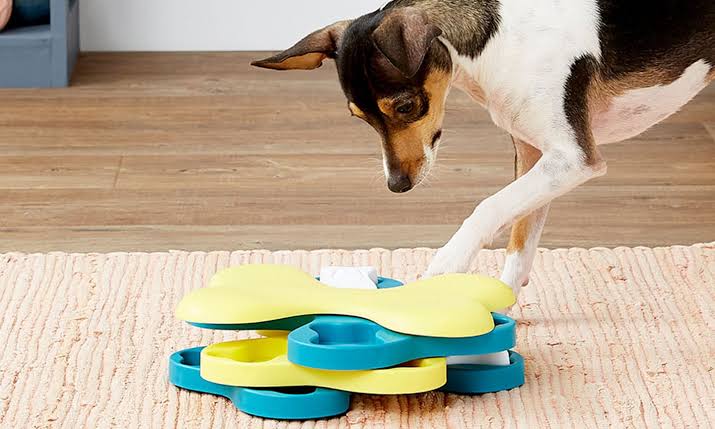
3. Nina Ottosson Puzzle Toys — One of the most respected names specifically in the dog puzzle category. These require your dog to slide, flip, or manipulate compartments to get to hidden treats, and they come in a range of difficulty levels, so you can start easy and work up as your dog gets better at problem-solving.
4. Snuffle mats — A genuinely underrated option. Scattering kibble or small treats into the fabric folds taps directly into a dog’s natural foraging instinct, and it’s a great low-intensity option for anxious dogs or for slowing down a dog who eats too fast. Also genuinely useful as a distraction during stressful moments, like thunderstorms or fireworks.
5. Flirt poles — If you’ve got a high-drive dog, this might be the single most effective interactive toy category out there. It’s essentially a long pole with a lure on the end that mimics prey movement, and because it requires you to actively participate, it naturally builds in structure — you can layer in commands like “sit” or “wait” before letting your dog chase, which turns playtime into impulse control training without your dog even realizing it’s training.
6. Motion-activated rolling or bouncing toys — Good for hands-free entertainment, especially for dogs who love chasing unpredictable movement. Just keep in mind these usually run on batteries or need charging, and they generally aren’t built to survive serious chewing, so they work best for dogs who chase and pounce rather than dogs who try to destroy everything they catch.
A Few Practical Tips
Rotate your toys. Dogs get bored with static toys fast, and most experts recommend cycling through your toy collection every few days to a week rather than leaving everything out all the time. A toy that’s always available loses a lot of its appeal — keeping your dog’s favorite puzzle put away except during dedicated play sessions actually makes it more exciting when it comes back out.
Match difficulty to your dog. A puzzle that’s too easy gets abandoned in minutes; one that’s too hard leads to frustration instead of engagement. Start simple and increase difficulty as your dog gets better at solving them.
Supervise new toys, especially with puppies or aggressive chewers. Any interactive toy can become a hazard if pieces break off and get swallowed. Inspect toys regularly for cracks, loose parts, or fraying, and retire anything that’s showing real wear.
You don’t need a huge toy box. One solid primary puzzle or engagement tool plus one or two supporting toys is genuinely plenty. Overloading your dog with options can actually dilute how engaging any single toy feels.
Read Also: Automatic & Smart Feeding Systems: Which Ones Are Worth the Investment?
Bottom Line
If you want one reliable, nearly indestructible go-to, a stuffed KONG is still hard to beat for the price. If you want to build real problem-solving skill over time, a Nina Ottosson puzzle or a West Paw Toppl gives you room to increase difficulty as your dog improves. And if you’ve got a genuinely high-energy dog who needs both physical and mental engagement, a flirt pole session — with a little training worked in — will probably tire them out faster than anything else on this list.
Whatever you go with, the real trick isn’t finding the “perfect” toy — it’s rotating what you’ve got and keeping things a little unpredictable, which is exactly what keeps a dog’s brain engaged in the first place.