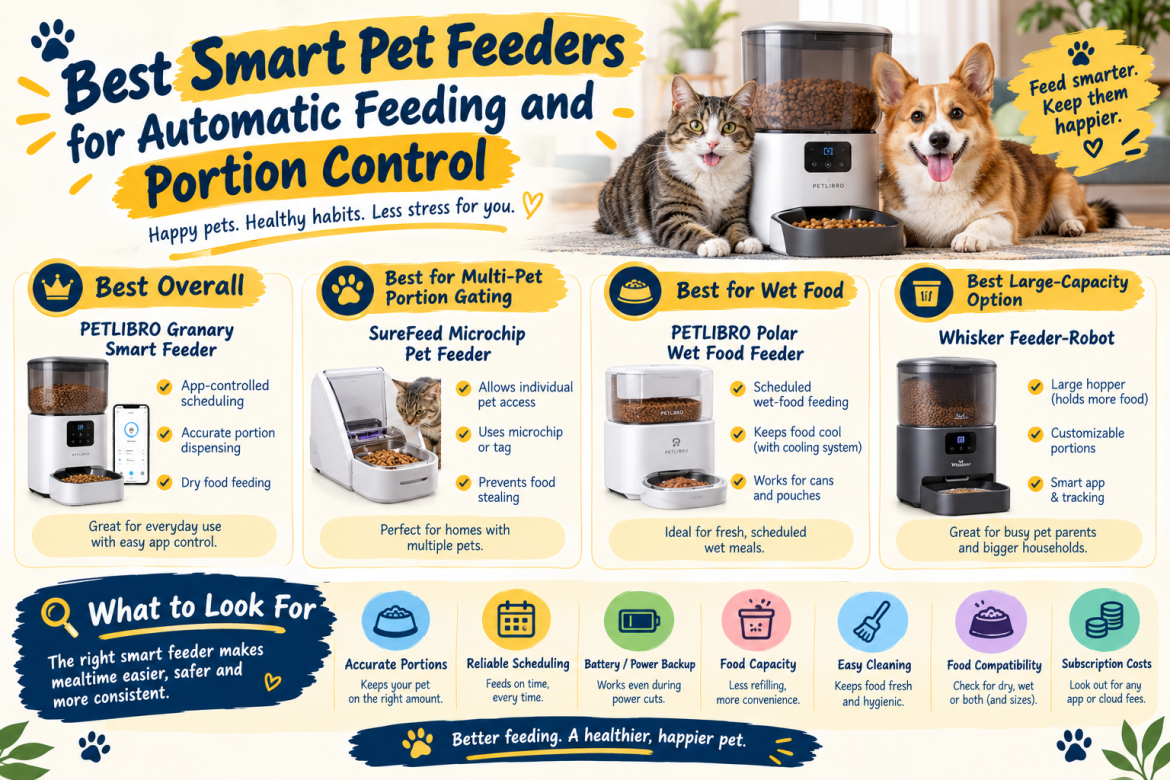
If you’ve ever been stuck at work running late while your dog stares at an empty bowl at home, or woken up at five a.m. to a cat yelling for breakfast, you may have wondered about a smart feeder. They can take some of the stress out of feeding schedules, and they can help with portion control, too.
Here’s what to know before buying one.
What is a smart feeder?
A smart pet feeder is a machine that dispenses food at set times and in set amounts. Some are simple timers with a bowl. Others connect to Wi-Fi, so you can control them from your phone, schedule meals, and get alerts.
Some even have cameras, microphones, and sensors, so you can check on your pet while you’re away.
Why people like them
The biggest reason is consistency. Pets thrive on routine, and a feeder helps keep meals on time even if your schedule changes. They’re also helpful for weight control, because you can measure exact portions.
They can ease anxiety for owners who travel or work long hours, and some help with pets who beg or eat too fast.
Things to consider first
Think about your pet’s needs. Do they eat dry food, wet food, or both? Is your pet on a prescription diet? Do you have more than one pet? Do you need to prevent one pet from stealing another’s food?
Talk to your vet if your pet has health issues, because feeding amounts and schedules matter.
Dry vs wet food
Most smart feeders are designed for dry kibble. Wet food is trickier, since it can spoil. A few models use cooling packs or sealed compartments for wet food, but these are limited, and you have to be careful about how long it sits out.
If your pet eats wet food, check the feeder’s specs closely.
Read Also: Do Pets Get Jealous? Understanding Animal Emotions
Portion control
Look at how precisely the feeder measures. Some dispense in small increments, like a tablespoon or a small number of grams, and some in bigger scoops. Smaller increments give more control, which helps with weight management.
Also consider whether you can set different amounts for different meals, such as a larger dinner and a smaller breakfast.
Capacity
Hopper size varies. A small capacity means frequent refills. A larger one can feed your pet for days or weeks. If you travel, make sure it has enough capacity for your longest trip, plus a safety margin.
Don’t forget that kibble can go stale in a large hopper over a long period, so look for airtight seals.
Connectivity
Wi-Fi feeders let you change schedules and trigger meals remotely. That’s convenient, but it also means you depend on your internet. Look for models with a backup, like batteries or an offline mode, so meals still come if the power or Wi-Fi goes out.
Check the app too. Read reviews about how reliable it is, because a clunky app can be frustrating.
Power and backup
Some feeders plug in, some use batteries, and some do both. A dual option is the safest. If the power goes out and your pet depends on the feeder, you want it to keep working.
Jam prevention
Kibble can get stuck, especially odd shapes or large pieces. Look for feeders with designs that reduce jamming, and check what kibble sizes they handle. Read owner reviews about how often jams happen.
Pet-proofing
Smart pets can be sneaky. Some will paw, flip, or chew at the feeder. Look for sturdy construction, locking lids, and designs that are hard to knock over. For big or determined dogs, this is especially important.
Multi-pet homes
If you have more than one pet, a feeder with microchip or collar tag recognition can make sure each pet only gets their own food. This helps if they have different diets, or if one tends to steal from the other.
Alternatively, separate feeders and rooms can do the job, too.
Cleaning
Feeders need regular cleaning, because oils from food can build up and go rancid. Look for removable, dishwasher-safe parts, and make sure it’s easy to take apart. A hard-to-clean feeder won’t get cleaned.
Camera features
Some models include a camera so you can watch your pet eat and check in on them. That can be fun and reassuring, but consider privacy and Wi-Fi security. Pick a brand that takes security seriously, and use strong passwords.
Popular brands
Names that often come up include PETLIBRO, PetSafe, Petkit, SureFlap (now Sure Petcare), and WOPET, among others. Some are budget-friendly, and some offer advanced features. Check current reviews and look for feedback from owners with pets like yours.
Getting your pet used to it
Introduce the feeder gradually. Let your pet sniff it while it’s off, then use it with a few treats. Some pets are startled by the sound of kibble dropping. Keep it positive, and be patient.
Don’t rely on the feeder fully right away. Stay nearby for the first few days, to see how it works and to troubleshoot.
Safety reminders
A feeder is a tool, not a replacement for attention. Check on your pet daily, make sure the feeder is working, and keep fresh water available. If you’re away, ask a friend or sitter to check in. Machines can fail.
Is it worth it?
For many households, yes. It’s a good way to keep meals consistent and portions accurate. For others, a simple bowl and a routine is plenty.
Think about your lifestyle and your pet’s needs, choose something sturdy and easy to clean, and make sure it has a backup. Then enjoy a few more peaceful mornings.