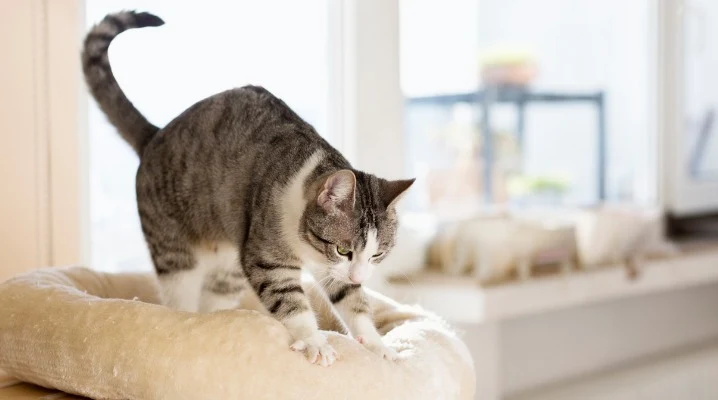
If you’ve lived with a cat, you know the move. They hop onto your lap, circle once or twice, and then start pressing their paws in and out against your thigh, one after the other, like they’re making tiny loaves of bread. Sometimes there’s purring. Sometimes there’s drool. Sometimes there are claws, which, ouch.
People call it “making biscuits,” and it’s one of those cat behaviors that’s both adorable and a bit mysterious. So what’s actually going on?
It starts when they’re kittens
The most widely accepted explanation goes back to the very beginning of a cat’s life. Newborn kittens knead their mother’s belly while nursing. The pressing motion helps stimulate the flow of milk. It’s instinct, and it’s tied to warmth, safety, and food.
That’s why a lot of cats keep doing it as adults. The behavior gets linked to comfort. When your cat kneads your lap or a soft blanket, they may be tapping into that old feeling of being a content kitten. It’s a bit like how you might feel pulled toward a childhood comfort food when life gets stressful.
It means they feel safe with you
When a cat kneads you, take it as a compliment. Cats don’t usually relax like that around things they don’t trust. If your cat is pressing into your lap, half-asleep, purring away, they’re telling you that you’re a safe place.
I always think of it as the cat equivalent of kicking off your shoes at a friend’s house. They’re comfortable. They’re not on guard. You’re part of their world.
They’re getting a bed ready
There’s another theory that goes back to wild ancestors. Wild cats would trample down grass, leaves, or brush to make a comfortable sleeping spot, and also to check it over for anything hiding in there. Your cat’s blanket may not have snakes in it, but the instinct is still there.
You’ll often see cats knead a spot, turn around, knead again, and then settle. It’s a little ritual. They’re basically fluffing their own pillow.
Read Also: Best Air-Dried Dog Food Brands Worth Buying
They’re leaving their scent
Cats have scent glands in their paw pads. When they knead, they leave behind a bit of their scent on whatever they’re pressing. That’s a way of marking something as theirs, and it’s not aggressive, just a quiet “this is mine, and this smells like home.”
So when your cat kneads you, there’s a small chance they’re claiming you. Don’t take it personally. It’s affection, in cat terms.
Why do they do it to me, specifically?
Because you’re warm, soft, and familiar, and because you probably make them feel good. If you pet them while they knead, or talk to them in a gentle voice, that reinforces it. Cats are quick to learn what gets a positive reaction.
Some cats go for a certain spot every time, like the same blanket, the same cushion, or your stomach. It’s their favorite, and they’ll keep returning to it.
What about the drooling and sucking?
Some cats drool or even suckle on fabric while kneading. It looks odd, but it’s usually just a sign of deep relaxation, tied to those early nursing memories. Cats who were weaned early, or separated from their mothers young, sometimes do it more.
In most cases it’s harmless. If your cat is chewing or eating the fabric rather than just sucking on it, that’s something to mention to your vet, since swallowing fabric can cause serious problems.
Is kneading ever a sign of a problem?
Usually not. Most of the time, it’s just a content cat being a cat. But a few things are worth noticing.
If your cat starts kneading far more than usual, or seems anxious while doing it, stress could be a factor. Changes at home, like a new pet, a move, or a different routine, can make some cats lean harder on comforting habits.
And if kneading is paired with other changes, like hiding, not eating, or aggression, it’s worth checking in with a vet. Kneading by itself is rarely the issue, but it can be part of a bigger picture.
How to deal with the claws
Here’s the real problem for most owners. Kneading is sweet until the claws come out. A few things that help:
Keep your cat’s nails trimmed. It sounds simple, but it makes a huge difference. A quick trim every couple of weeks and kneading becomes far more comfortable.
Put a thick blanket or a folded towel on your lap before your cat settles in. It gives you a barrier and gives them something satisfying to press into.
Don’t punish your cat for it. They aren’t trying to hurt you, and scolding can confuse them or damage trust. If it hurts, gently lift them off and place them on the blanket instead, or offer a toy or a soft cushion as a replacement.
If your cat gets a bit too intense, you can calmly move them, wait a moment, and let them try again on a softer surface. Over time, many cats learn where kneading is more welcome.
Should you stop it?
I wouldn’t. It’s a natural, healthy behavior, and it’s a window into how your cat feels. Instead of stopping it, just make it more comfortable for both of you.
I’ve had cats who kneaded me for ten minutes straight and then fell asleep right there on my chest, and honestly, those were some of the best moments of the day. It’s hard to feel stressed when a purring cat is working your shirt like dough.
The bottom line
Cats knead for a mix of reasons: it’s an old kitten habit, it’s a comfort ritual, it helps them get a bed ready, and it spreads their scent. Mostly it means they feel safe and happy.
So next time your cat starts making biscuits on you, try to enjoy it, keep a blanket handy, and feel a little proud. You’ve earned that trust.